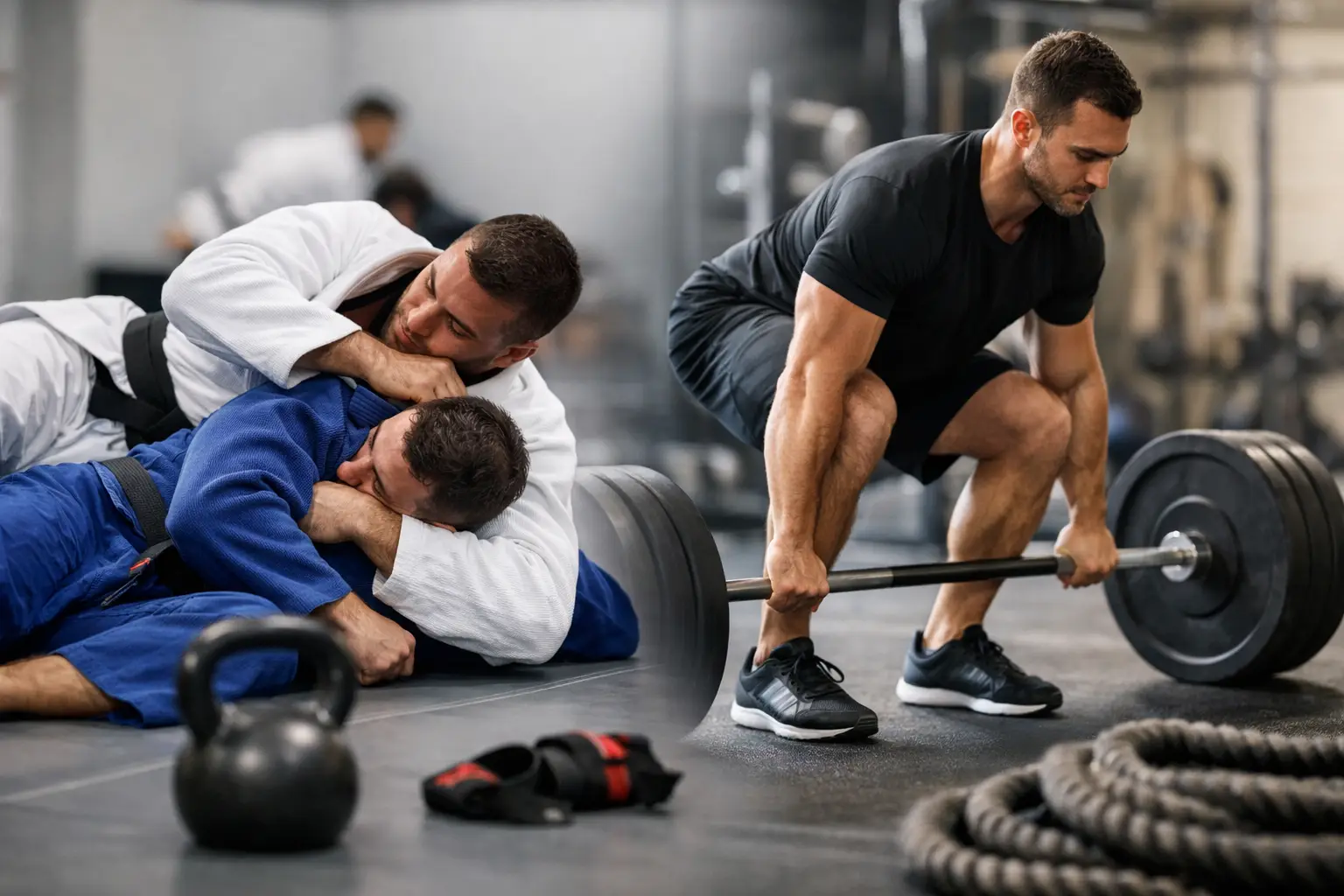
A 315-pound deadlift does not automatically make someone difficult to sweep. But when strength lets you finish a takedown, maintain posture under pressure, or stand up late in a hard round without your back folding, it matters. Useful BJJ strength standards are not about chasing gym numbers for their own sake. They give grapplers a clear way to build force, resilience, and confidence that carry over to the mat.
The right standard depends on your bodyweight, training age, injury history, current BJJ schedule, and competitive goals. A masters hobbyist training three nights a week needs a different target and timeline than a healthy adult preparing for a tournament. The goal is not to be strong at the expense of your jiu-jitsu. It is to develop enough strength that your body stops being the limiting factor.
BJJ Strength Standards Are Performance Markers, Not a Scoreboard
General strength tables can be useful, but they rarely account for the realities of grappling. BJJ asks you to produce force from awkward positions, pull while rotating, brace against a resisting opponent, and repeat those efforts while fatigued. A clean barbell lift measures part of that equation, not all of it.
For that reason, a useful standard should pass three tests. It should be relative to your bodyweight, performed with stable technique, and supported by movement quality. If a heavier squat irritates your knee for a week or a max deadlift wrecks your next two training sessions, that number is not currently serving your jiu-jitsu.
Think of strength standards as guardrails for long-term development. They show where you are underprepared, help you set realistic priorities, and keep your gym work measurable. They do not rank your value as a grappler. A lighter athlete with excellent timing may outperform a stronger athlete every round. Strength simply gives skill more usable options.
Practical BJJ Strength Standards for Grapplers
The following targets are long-term benchmarks for healthy adult grapplers with consistent strength training experience. They are not entry requirements. Newer lifters should earn positions, learn technique, and build volume before testing heavier loads.
Lower-Body Force: Squat, Hinge, and Single-Leg Control
Your lower body drives takedowns, guard retention, bridges, technical stand-ups, and scrambles. For many grapplers, a controlled squat or trap-bar deadlift is a better measure of useful force than a single all-out barbell max.
A solid intermediate target is a technically sound squat in the range of 1.25 to 1.5 times bodyweight for a hard single or a conservative three-rep set. More experienced athletes may work toward 1.5 to 1.75 times bodyweight, provided they can recover from it and maintain depth, bracing, and joint control.
For hinging, a trap-bar or conventional deadlift of roughly 1.5 to 2 times bodyweight is a strong long-term range. The lower end is already plenty useful for many committed recreational students. If your schedule includes hard wrestling rounds, open mats, and competition training, chasing the upper end may not be the best use of recovery resources.
Single-leg strength deserves equal attention. A grappler who can perform controlled Bulgarian split squats, step-ups, and single-leg Romanian deadlifts without knee collapse or hip shifting is building a base that carries into shots, base recovery, and passing pressure. These movements are harder to reduce to a single universal number, so use range of motion, control, and progressive loading as your standard.
Pulling Strength: Build the Back That Holds Position
Pulling strength matters everywhere in BJJ: finishing a single leg, keeping an opponent broken down, controlling sleeves or collars, and resisting posture breaks from guard. It also helps balance the shoulder demands created by gripping, framing, and posting.
A practical target for most grapplers is 8 to 12 strict pull-ups with a full hang, no kicking, and consistent chin clearance. Once that is established, weighted pull-ups can be progressed gradually. A strong advanced benchmark is a clean pull-up with an additional 25 to 50 percent of bodyweight, depending on size, shoulder history, and grip style.
Rows matter too, especially for athletes who cannot tolerate high pull-up volume. Chest-supported rows, ring rows, cable rows, and dumbbell rows can all build the upper-back strength needed for posture and control. The best choice is the one you can load consistently without turning your shoulders and elbows into a recovery problem.
Pressing Strength: Enough Force, Better Shoulder Control
Pressing is useful for frames, posting, hand fighting, and getting off the bottom, but it has a narrower margin for error than pulling. BJJ already puts shoulders in compromised ranges. Your pressing work should build force while improving control of the scapula and trunk.
For a healthy athlete, a bench press around 0.75 to 1.25 times bodyweight is a reasonable general range. But a pain-free dumbbell press, push-up variation, or landmine press may be more valuable than a heavier barbell number. If your shoulders are irritated from training, pressing less and prioritizing pulling, carries, and rotator cuff work is often the smarter move.
A better practical standard than a max bench is the ability to perform high-quality push-ups with a rigid trunk and shoulders that remain stable throughout the set. If you cannot control your own bodyweight, adding more load is rarely the answer.
Carries, Grip, and Trunk Strength: The Transfer Layer
Carries connect grip, trunk stiffness, posture, and gait. They are one of the clearest ways to prepare for the feeling of controlling a heavy, moving person. Farmer carries, suitcase carries, front-rack carries, and sandbag carries all expose weak links that standard lifts can hide.
A useful baseline is carrying roughly half your bodyweight in each hand for 30 to 45 seconds with tall posture and no excessive leaning. That target will vary with equipment and hand size, so treat it as a progression marker rather than a pass-fail test. Sandbag carries are especially valuable because the shifting load demands the bracing and positional adjustment familiar to grapplers.
Grip strength should support your game, not destroy your elbows. Towel hangs, gi pull-ups, rope work, thick-grip carries, and controlled dead hangs can build endurance for gripping exchanges. Rotate the stimulus instead of maxing out grip work after every class. Persistent medial elbow pain is a signal to reduce intensity and improve total workload management.
Power and Mat Endurance Need Their Own Standards
Being strong slowly is not the same as being explosive. A takedown entry, bridge, or scramble often depends on how quickly you can use the strength you have. Low-volume jumps, medicine-ball throws, kettlebell swings, and explosive push-ups can develop power without the fatigue cost of repeated max lifting.
A simple power standard is repeatability. Can you perform crisp jumps or throws across several low-rep sets without losing landing quality, speed, or position? Stop the set when output drops. Power training is not conditioning disguised as explosive work.
Mat endurance also needs a separate lens. If your lifts improve but you fade after two hard rounds, your conditioning system needs attention. The answer is not always more high-intensity circuits. Build an aerobic base with low-intensity work, then use controlled intervals that reflect your competition pace and training phase. Strength training should support this work, not compete with it.
How to Use Standards Without Overtraining
Test only when you are reasonably recovered. Avoid assessing heavy lifts after an open mat, a hard week of sparring, or a poor night of sleep. For most grapplers, testing every 8 to 12 weeks is enough to identify progress without turning training into a constant evaluation.
Track more than load. Record bodyweight, reps, technique notes, pain levels, sleep, and how your body feels during rolling. A deadlift that stays the same while your rounds feel sharper, your knees feel better, and your recovery improves may still represent meaningful progress.
Organize training around your BJJ calendar. During a hard competition block, maintain strength with lower volume and keep soreness under control. In an off-season or lower-intensity period, build more volume and address the weak links that showed up during competition. MatFlow applies this kind of phase-based structure so your lifting, conditioning, exercise alternatives, and recovery demands work together instead of colliding.
Train for the Positions You Want to Win
The strongest grappler in the room is not always the best-conditioned athlete or the most technical one. But the athlete who can repeatedly create force, hold position, recover well, and stay durable has more chances to apply skill when the round gets hard.
Use BJJ strength standards to identify your next physical priority, not to collect impressive numbers. Build steadily, adjust around pain and training volume, and let every improvement make you more capable in the positions that decide your rounds.